
Role of the protein engineering in generation ofisomorphous heavy atom derivatives |
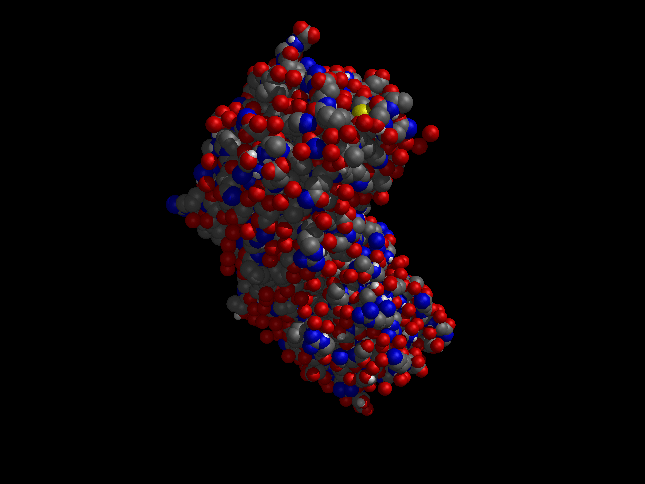
Cutinase - mutagenesis has been used here to introduce heavy-atom binding sites
Principles of preparation of heavy-atom derivatives
Conventionally heavy-atom derivatives are obtained by soaking crystals in solution containing of heavy-atom compound . Amino acid side chains (like cysteine, methionine) react covalently with heavy-atom compounds. Heavy-atom reagents form also ionic bonds with charged groups or occupy in a binding pockets. Soaking time may vary from minutes up to several weeks. The properties of heavy atom compounds can be found on the web (list of heavy metal reagents at Birkbeck College)
Problems with preparation of heavy-atom derivatives
Soaking is time consuming and requires many good crystals. Serious problems arise when reactive side chains are placed near crystal contacts. Reaction between heavy metal compounds and these amino acids often causes cracking of crystals or results in non-isomorphous crystals. In other cases protein molecules do not contain binding sites for heavy-atom reagents and preparation of derivatives is very difficult. In such cases protein engineering has been used to obtain protein crystals with good ability to bind heavy atoms compounds.
The use of mutagenesis for the preparation of heavy-atom derivatives
Mutagenesis has been used to introduce heavy-atom binding sites (e.g. cysteine) into protein. This was first achieved using T4 lysosyme [10] and applied to solve structure of gamma-delta resolvase [11] Cysteine residues are ideally on the surface where they are accessible to solvent and unlikely to disrupt the core structure of protein. Serine is similar to cysteine in size and Ser-to-Cys is unlikely to cause a structural change of protein or affect crystal contacts. Now I would like discuss some examples:
Examples of protein structure determination that have been
facilitated by protein engineering
Part I Mutagenesis for heavy atom derivatives
| Structure | Mutations | Comments | References |
| Ribosomal protein L6 from Bacillus stearothermophilus | Val 124 Cys | This protein was crystallized, but no derivatives could be made. Native protein does not have natural cysteine residues. | [12] |
| Ribosomal protein L9 from Bacillus stearothermophilus | Succesful mutations: Asn 27 Cys, Glu 100 Cys, Leu 35 Met and Leu 124 Met | Crystals were first grown in 1979, but the structure proved insoluble. Cysteine mutants gave the best crystals, but were nonisomorpic. Methionine mutations were introduced in order to label with selenomethionine | [13] |
| Cutinase from Fusarium solani | Ser(4, 92, 120, 129) Cys | From 14 possible mutants, four crystallized isomorphously to the native enzyme, leading to useful derivatives. | [14] |
| Glutathione S-transferase | Cys 86 Ser, Cys 114 Ser, Cys 173 Ser | Mutagenesis played here an important role in the solution of the structure in that the cysteine mutants were used to help locate the positions of mercuric ion sites in nonisomorphous derivatives | [15] |
| Ubiquitin-conjugating enzyme E2 from Arabidopsis thaliana | Cys 114 Ser | Reaction of the two cysteines in wild type with heavy-atom compounds resulted in derivatives non-isomorphous to the native crystals. This mutation solved this problem - reaction with heavy-atom compounds resulted with 3 useful derivatives | [16] |
| RNA-binding domain of U1A protein from Homo sapiens | Ser 29 Cys, Gln 39 Cys, Gln 54 Cys, Glu 61 Cys, Ser 71 Cys, Gln 85 Cys | All mutants were pre-reacted with heavy-atom compounds, with the exception of Gln 85 Cys | [17] |
[Back]
 [Index]
 [PPS]
[PPS]
 [Next]