Chemotaxis
Escherichia coli swims by rotating helical flagellar filaments. E.coli is attracted to various sugars and amino acids and repelled by fatty acids and other noxious compounds with the cells determining their heading in chemical gradients by measuring temporal concentration changes as they move about.
The intracellular signalling machinery is more elaborate than the two component regulatory system described for osmotic sensing. In addition to various chemoreceptors, the cytoplasmic proteins CheA, CheB, CheR, CheW, CheY and CheZ are needed to process the sensory signals and transmit control signals to the flagellar motors.
E.coli has 4 methyl-accepting chemotaxis proteins (MCPs) that mediate responses to serine (Tsr), aspartate and maltose (Tar), ribose and galactose (Trg), and dipeptides (Tap). These MCPs are transmembrane proteins of 550 amino acids. The signalling domain of the MCP modulates the activity of the transmitter-containing CheA protein to elicit chemotactic responses. CheW couples CheA to chemoreceptor control by promoting formation of a complex of an MCP dimer, two CheW monomers and a CheA dimer.
CheA is a cytoplasmic histidine kinase with unusual structural organisation. Its transmitter is located centrally between two additional domains. The C-terminus couples CheA to CheW and the chemoreceptors. The phospho-accepting histidine is outside the transmitter module in a small N-terminal domain. CheA donates its phosphates to CheB and CheY.
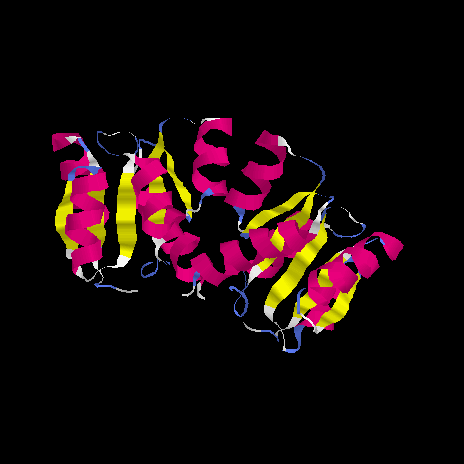
CheY consists entirely of conserved N-terminal response regulator domains. It is a single domain protein with a doubly wound five-stranded parallel beta sheet surrounded by five alpha helices. Asp-12, Asp-13 and Asp-57 are clustered to form an acidic pocket, which constitutes the phosphorylation site of the protein. Asp-57 is the phosphoacceptor. Divalent metal ions are essential for the transfer of phosphate to CheY. The acidic pocket acts as a magnesium ion-binding site. Lys-109 also has a functionally important role; the side chain epsilon-amino group is bound to one of the beta-carboxylate side chain oxygens of Asp-57. Phosphorylation of Asp-57 causes a local adjustment of the carboxyl side chain and a repositioning of the Lys-109 side chain. These arrangements in the active site give rise to larger-scale conformational changes and results in active protein able to interact with the flagellar switch proteins.
Summary of Chey structural properties in CATH databaseCheY
Go to Next Page
Go to Previous Page