Some sequences, because of their ability to acquire a secondary structure can lead to different kinds of mutations. Mutations such as: expansion (dynamic mutation), chromosomal aberration (e.g. deletion of a dystal end of chromosome 11), deletions and insertions (mutational hotstpots) are connected to changes in the DNA structure.
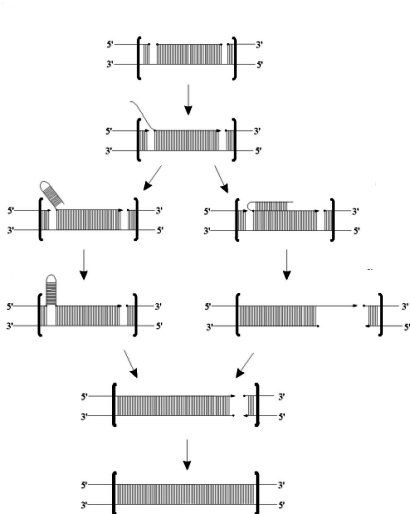
Sequences with tandem repeats of trinucleotide motive can undergo expansion because of their ability to form a secondary structure known as a hairpin. If the new synthesised strand gets slipped on the matrix and folds into a hairpin a fragment of the matrix will be replicated twice leading to extension of this sequence. The same mechanism may lead to deletion from the repeated region. The difference lies in the location of the hairpin; if it is formed on the leading strand we can observe deletion and if on the lagging strand we are dealing with expansion. Trinucleotide repeats known to undergo such changes are regarded as a cause of many neurodegenerative diseases such as fragile X, Kennedy’s disease or miotonic dystrophy.
Expansion of the CGG element contributes to breakage in the chromosome 11, resulting in Jacobsen disease. It can be postulated that such a sequence forms a secondary structure (kind of Z-DNA?) which prevents establishing assemblies with nucleosomes and thus is the main cause of this mutation.
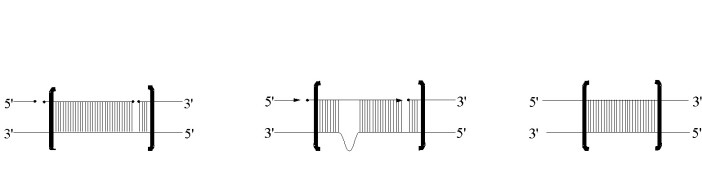
Many sites in human genome is more than the others susceptible to mutations such as deletions and insertions (hotspots). These regions usually contain palindromic sequences capable of folding into hairpins, which can be cut out of the DNA strand (deletion) or be subject to double replication (insertion).