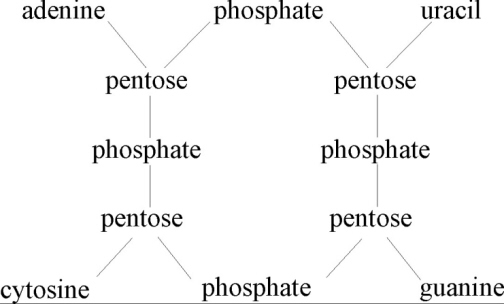
Interest in structure of nucleic acids date from 1909 when Levene and Jacobs began reinvestigation of the structure of nucleotides. Finding that DNA was the long searched for genetic substance, gave further push leading to the nucleic acid research which has evolved now into several important fields of modern genetics, molecular biology and biochemistry.
Nucleic acids obtained from yeast yielded after a mild alkaline hydrolysis four pentose-nucleosides: adenosine, cytidine, guanosine, and uridine. Quite large amounts of nucleic acids were also isolated from thymus. Despite similarities this kind of nucleic acids could not be hydrolised by used before alkaline hydrolysis. It was only successfully degraded into deoxynucleotides in 1929 when Lavene adopted enzymes to hydrolyse deoxyribonucleic acid followed by mild acidic hydrolysis. He identified its pentose as the before unknown 2-deoxy-D-ribose and four bases adenosine, cytidine, guanosine and thimine.
Up to 1940 most groups of workers were convinced that hydrolysis of nucleic acids gave the appropriate four bases in equal relative proportions. Unfortunately enough the discovery led to a tetranucleotide hypothesis for the structure of both thymus and yeast nucleic acids, which retarded further progress on the molecular structure of nucleic acids. There were a few different proposals of the structure. They all had four arbitrary located nucleosides joined together by four phosphate residues in a variety of ways. The only but with huge importance facts which could not be agreed with this model was a high molecular weight of native DNA molecules and Avery’s work which showed that DNA was responsible for complete transforming the behaviour of bacteria.
Further discoveries (DNA was cut into mononucleotides by a nuclease, beta configuration of glycosidic linkage in ribonucleosides, chemical synthesis of short oligonucleotides) led to assumption that nucleic acids form a linear polimer in which each deoxyribonucleotide is linked to the next by means of a 3’- to 5’ phosphodiester bond. Because there were no known ways of obtaining the sequence of polinuclotides the researches concentrated themselves on different approaches to construct the secondary structure. It was belived, for example, that the bases point outward from the structure.
The next step was done by Erwin Chargaff who began to investigate the base composition of DNA from a variety of sources using the new technique of paper chromatography. His data showed that there is a variation between samples of DNA from different species but this is overridden 1:1 ratio of thymidyne and adenine and also cytosine and guanine. Although the ratio of (T+A):(G+C) varies from species to species, different tissues from a single species give DNA of the same composition. Chargaff’s resultes finally discredited the tetranucleotide hypothesis as it called for equal amounts of four bases.
Francis Crick and Jim Watson from the beginning were persuaded to the model building approach which led Pauling and Corey to the alpha helix structure for peptides. They took advantage of published and unpublished resultes obtained by other researches. The best X-ray diffraction results came from King’s Collage, London. It was clear that DNA fibres posses a helical structure. Results suggested that DNA should be kept in moisture and that there is a difference between fibres of DNA in low humidity (A form) and high humidity (B form). Rosalind Franklin, one of the scientists greatly involved in the research, decided that such a behaviour requires the phophate groups to be exposed to water on the outside of the helix, with bases on the inside of the helix. Watson and Crick recognised the importance of the finding. The model built by them was a double, left-handed helix with bases facing the core of the helix and binding to each other thanks to the rule that A binds only with T and G only with C (complementary base pairing). 1953, the year when they published a helical model of DNA, is considered to be the beginning of modern biology.